Servers and playing with friends
Broodwing servers hold 35 players; joining through a friend's profile or an invite is the reliable way onto the same server, and a full server means waiting for a slot rather than switching regions.
Broodwing servers hold 35 players. That number shapes everything about how the game feels: a family is a real group, the pond is never crowded for long, and finding a specific friend is a small logistical problem rather than an impossible one.
The server cap
| Item | Value |
|---|---|
| Players per server | 35 |
| Players online at snapshot | 1,733 (2026-11-01 08:12) |
| Approximate servers at that moment | around fifty |
Thirty-five is small for a Roblox survival game. Most social games run 50 to 100 per server; 35 makes every bird visible and every nest findable, which is exactly what a family game wants.
Getting into the same server as a friend
Roblox gives you three reliable routes, and they are not equally good.
| Method | How it works | Reliability |
|---|---|---|
| Join from a friend's profile | If your friend is in Broodwing, their profile shows a Join button | High, while the server has space |
| Invite from inside the game | The in-game menu can invite a friend on Roblox | High |
| Join the same public server | Both players pick the same server from the game page's server list | Medium: servers fill, and the list changes |
The profile route is the one to use. It puts you in the exact server your friend is in, and it fails only when that server is full.
What to do when the server is full
A 35-player cap fills fast during peak hours, and a full server refuses joins. The practical options, in order:
- Wait for a slot. Sessions end constantly; a full server usually has space within minutes.
- Have your friend join you instead. One of you is always able to move.
- Pick a quieter server together. The server list on the game page shows population; both of you join a low-population one at the same time.
What does not work is joining repeatedly and hoping: Roblox does not queue you into a specific server, it puts you wherever there is space.
Families across a server
A family exists inside one server. If your group splits across two servers, you are two families that cannot see each other - there is no cross-server chat or shared nest.
That makes the pre-session agreement the most important part of group play: agree on a server before anyone starts playing, and have one person join first so the others can follow from their profile.
Playing with strangers
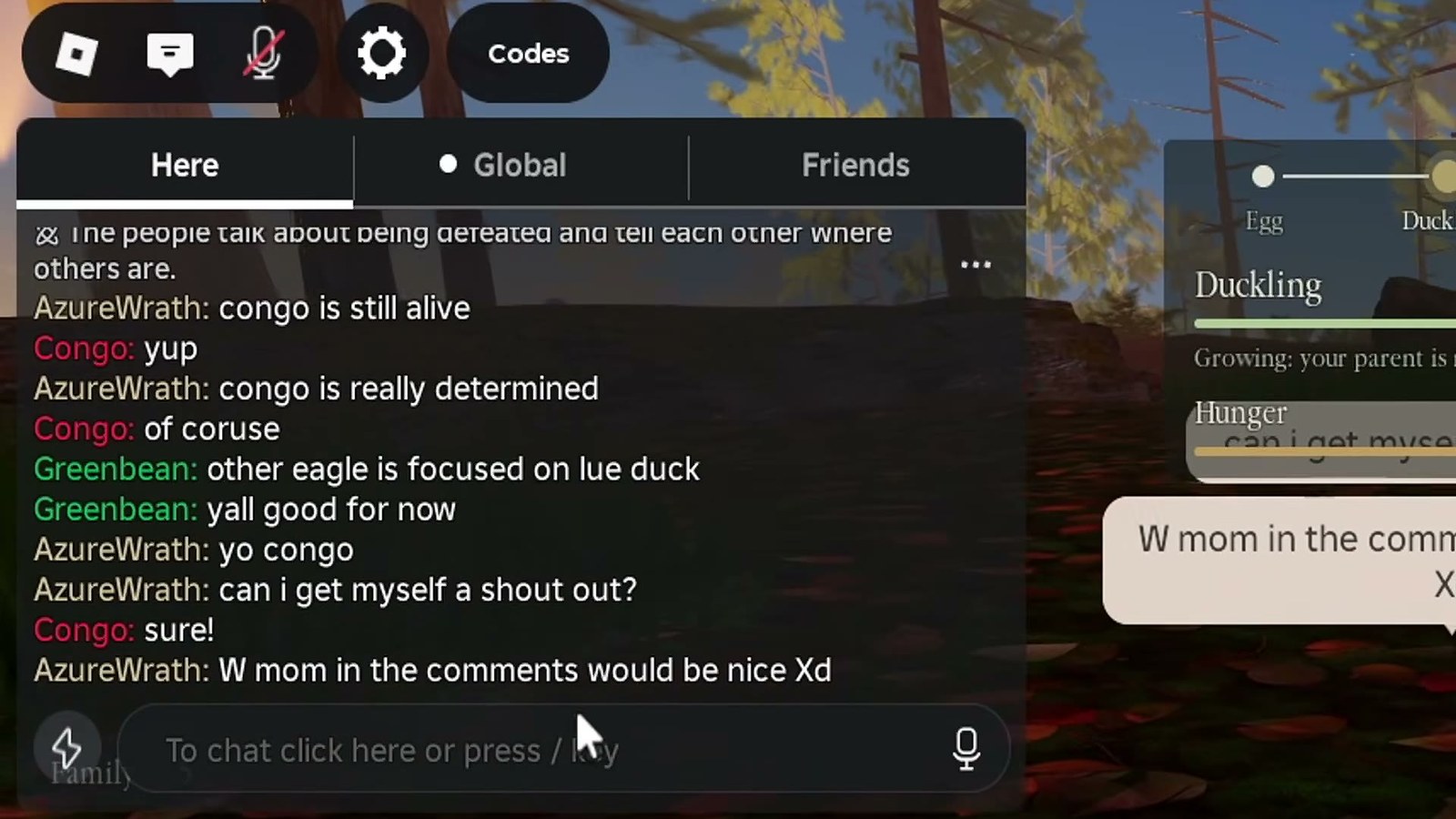
The 35-player cap makes public servers surprisingly social. With that few players, you will recognise names across a session, and a family that feeds a stranger's chick often gains a member.
Two habits make it work:
- Feed first, ask later. A chick that gets a fish remembers the bird that brought it.
- Do not chase people off your shoreline. A territory is held by nesting there, not by patrol; the family page covers how groups hold ground without griefing.
Server size and performance
A smaller server is also a performance decision. With 35 players and a large valley, Broodwing has fewer characters and physics objects in view than a 100-player game, which is part of why it runs on lower-end devices.
If you are playing on a phone or an older laptop, that is worth knowing: the server cap is working in your favour, and dropping graphics settings usually gets you a stable frame rate on a 35-player server.
Private servers
Roblox games can offer private servers as a paid extra, and Broodwing's store does not list one among its six passes. If a private server option appears, it will show up on the game page rather than in the pass list, and it would change the family logistics considerably - a private server means your group is the only group.
Until then, the public server is the only server, and the 35-player cap is the only constraint.
Practical checklist for a group session
- Agree a time and a server-joining order.
- One player joins first and stays put; the others join from that player's profile.
- Meet at a landmark - the pond is the easiest - before anyone builds.
- Decide the nest site as a group, then let one player build.
- If someone drops, they rejoin from the same profile, not from the game page.
That routine takes two minutes and saves the twenty minutes a split group usually wastes.
Related pages
The family page covers roles and organisation once you are in the same server. The game stats page explains what the online count means for how full your server will be, and the controls page has the settings that keep a 35-player valley smooth.
Server etiquette that keeps a group together
With 35 players, a server has room for about four or five families before it starts to feel crowded. That changes what good behaviour looks like.
| Situation | What helps | What does not |
|---|---|---|
| Another family nests nearby | Share the shoreline; fish move | Flying at them to scare them off |
| A stranger lands on your nest | Feed once, then watch | Chasing them across the valley |
| Someone asks for food in chat | Drop a fish if you have one | Ignoring them and complaining later |
| A griefer keeps returning | Move the nest; report if it continues | Fighting them for an hour |
The reason etiquette matters here is mechanical: a 35-player server is small enough that a bad neighbour is in every session and a good one becomes a family member. The family page covers the group side; this is the neighbourhood side.